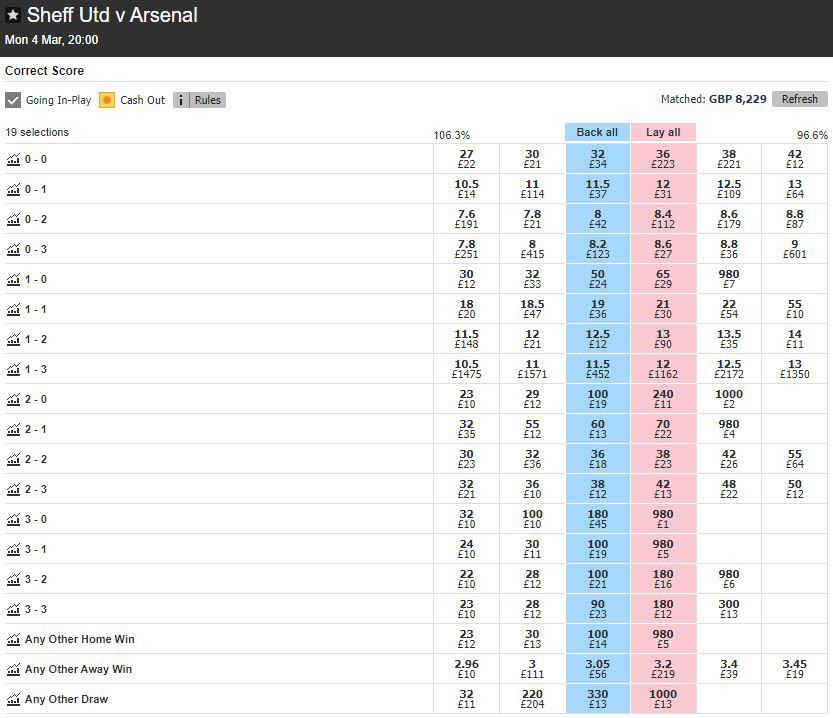


Correct score trading involves backing and laying scorelines on a betting exchange such as Betfair before and during a match.
Unlike a traditional correct score bet, you do not necessarily need to predict the final score because you can trade out before full-time.
It is one of the most exciting and enjoyable ways to trade football on Betfair.
It is just one of many approaches to football trading, but it is especially appealing because the correct score market can move quickly as a match develops.
It's not easy to predict exact football results since a match can end 0-0, 4-0, 3-3 or any other score. However, it's this challenge that makes trading correct scores so much fun!
At Goal Profits, we use several Correct Score trading strategies based around backing different target scores. Later in the article, I’ll also explain how Assured Soccer Profits takes a different approach to this.
Everybody has a different attitude to trading and may find that one method suits them better than the other.
In this article, I will explain how correct score trading works and look at some of the different strategies you can use.
How does the Correct Score market work?
Most beginners know how the Match Odds market works. It's very popular with bettors who back the home or away win as well as new football traders who lay the draw.
Match Odds is a simple market with 3 possible outcomes:
- Home win
- Away win
- Draw
On the other hand, the Correct Score market on Betfair is a bit more complicated because it has 19 possible scores!
Here's an example of the Betfair CS market for a fixture between Sheffield United and Arsenal in the English Premier League.
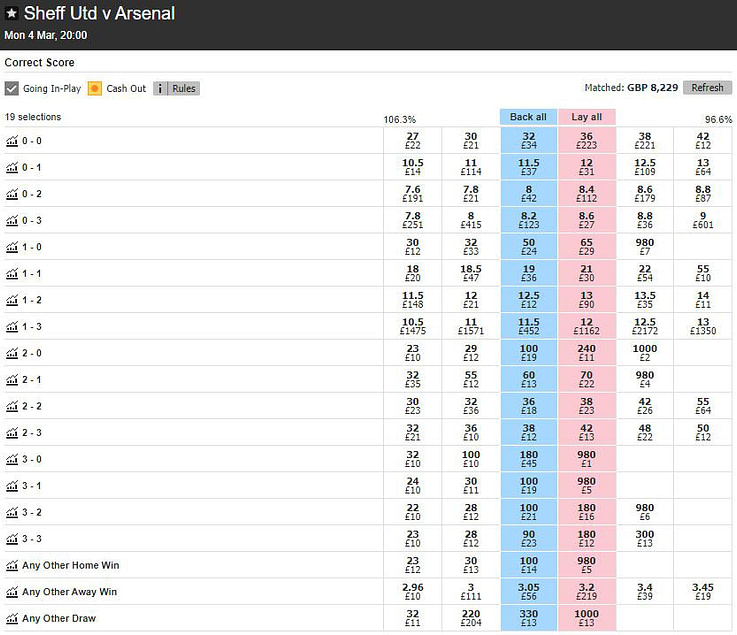
You can see all scores between 0-0 and 3-3 plus some 'Any Other' options.
- AOH = Any Other Home Win
- AOA = Any Other Away Win
- AOD = Any Other Draw
These cover scores in which at least one of the teams scores 4 (or more) goals.
For example, 'Any Other Home Win' covers 4-1 while 'Any Other Draw' will pay out if a game ends 4-4.
These scores are not too common, even when strong 'elite' teams are playing against much weaker opposition. The prices can be very attractive, but you won't hit them often.
Correct score betting vs trading
If you choose to bet on correct scores, you need to predict which exact score will come in, not just the outcome of the game in terms of home win, away win or draw.
You don't need me to tell you that it's far more difficult to predict that Arsenal will win 1-3 than it is to simply predict that they will win the game.
Of course, the market knows this and you will get a much better price than you will for simply backing The Gunners to pick up the 3 points.
Correct Score trading works differently.
Instead of placing a bet and then hoping that everything goes your way, you can back and lay scores before kick-off or during the match as it develops.
You can also use Dutching to cover several possible scores rather than relying on just one.
But with trading, you are able to chip away at the liability and - if things go to plan - lock in some profit, or leave yourself with a free bet on one or more scorelines before the game ends.
Correct score trading can be really quite simple or as complicated as you wish to make it. I guess that’s the beauty of this particular market on Betfair; it is incredibly flexible.
Of course, in order to have profit (green) somewhere on a Betfair market, there also has to be liability (red).
As with any other football trade, you are in complete control of your liability.
You can choose exactly how much red you are prepared to risk from your betting bank in order to potentially reward yourself with green.
Target score trading
Target score trading (also known as 'scattergun') is where you pick out clusters of scores and trade around them as goals go in.
For example, if you think that the final score will be 2-0 you may decide to cover 2-1 and 3-0 as well. If the home team goes 2-0 up you have a third goal covered either way.
Or, if you find a fixture that has a strong chance of both teams scoring, you can ignore 1-0, 2-0, 3-0 and 0-1, 0-2, 0-3 which narrows down your target score options significantly.
The great thing about correct score trading is that you don't need to predict the exact score in order to make a profit.
Getting near a target score or two in the second half can often give you an opportunity to secure a profit from the trade.
At Goal Profits, we have several 'target score' strategies.
Our main correct score strategies aim for either 3 or 4 goals in 90 minutes, or for a more aggressive approach, there is one that looks for 3 goals in the second half only.
These strategies are very popular with members because, when the right number of goals are scored at the right times, they have potential to produce large profits.
The key is to control losses while patiently waiting for the big winners to land.
Finding target score trades
There are literally dozens, if not hundreds, of ways to find suitable games for trading.
They all revolve in some way around past performance, whether it be recent form or previous seasons.
At Goal Profits, for example, members have access to various Team Stats shortlists that are generated daily and offer multiple filtering options.
Seasonal performance is one of the ways to narrow down potential matches.
Look for teams that perform consistently, perhaps scoring plenty of goals or keeping lots of clean sheets. That will give you a pointer as to what you can expect in future fixtures.
Our Today's Qualifiers page lists all of the matches that qualify for our Correct Score trading strategies, giving members a ready-made shortlist each day.
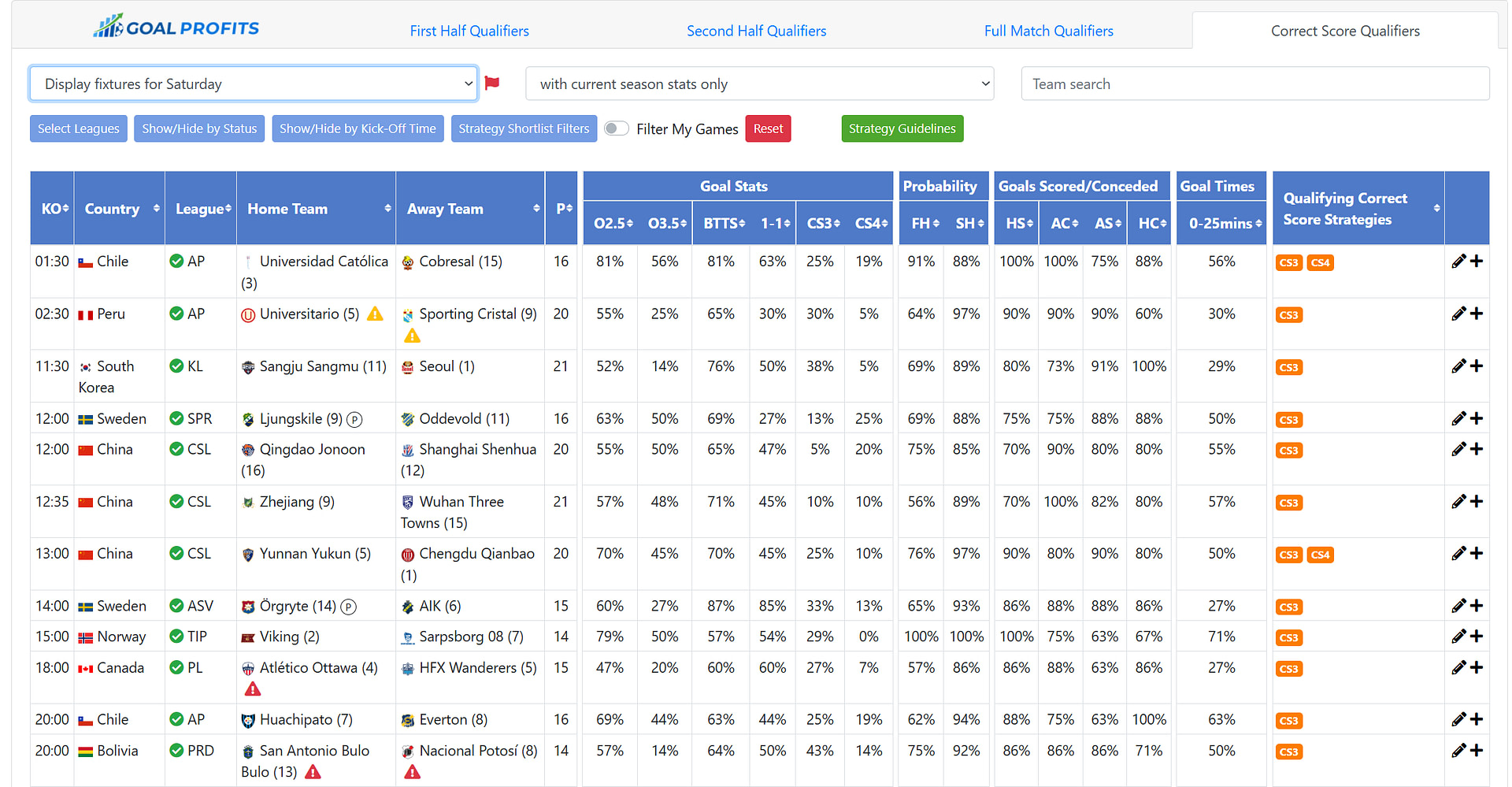
Ready to try our Correct Score strategies?
Goal Profits members get access to our daily qualifiers, football stats and full trading guides.
Remember that football is a wonderfully random game, so accurate correct score prediction is not easy.
Would you predict the final score of Arsenal v Wolves the same as Arsenal v Liverpool? Probably not, but both could end up with exactly the same result.
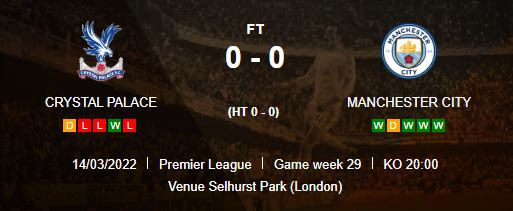
Oh... and Manchester City always score right? Wrong!
Even the best teams have a 0-0 result now and again.
One popular approach is to focus on recent results, often known as 'short form'.
No team goes through an entire season playing at their very best; they go through periods of high performance but will suffer dips in form.
Short-form traders find teams which are both playing well and anticipate that it will continue into the next fixture.
Some other traders use head-to-head results, known as 'H2H'.
The idea is that lightning often does strike twice but, with managers and players moving around so much these days, it's not a method I rely on myself.
H2H does give me some added confidence if I see that the same fixture last season had goals, but that's about it.
First half correct score trading
What you could think about is splitting fixtures in half.
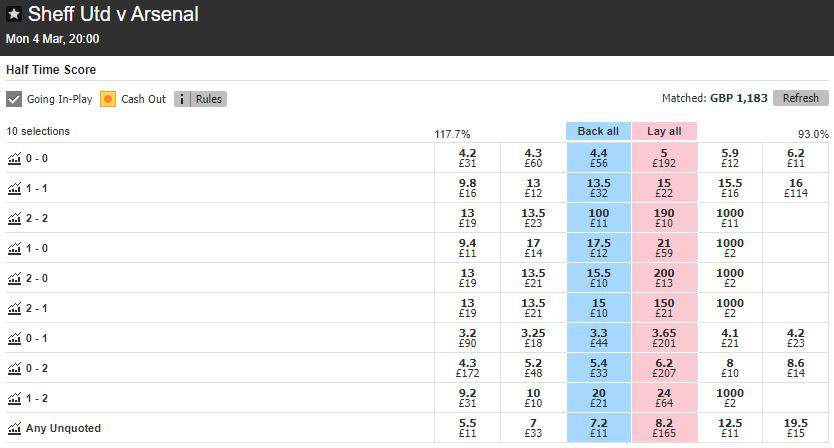
For one thing, the 'Half-Time Score' market on Betfair has 10 outcomes rather than the 19 in the full Correct Score market.
Also, our Team Stats Database (stats for more than 300,000 matches) shows us that the average game of football has 1.15 first half goals.
Only 11.1% of all games have 3 or more first half goals and 36.0% are 1-0 or 0-1 at the break. That narrows things down significantly.
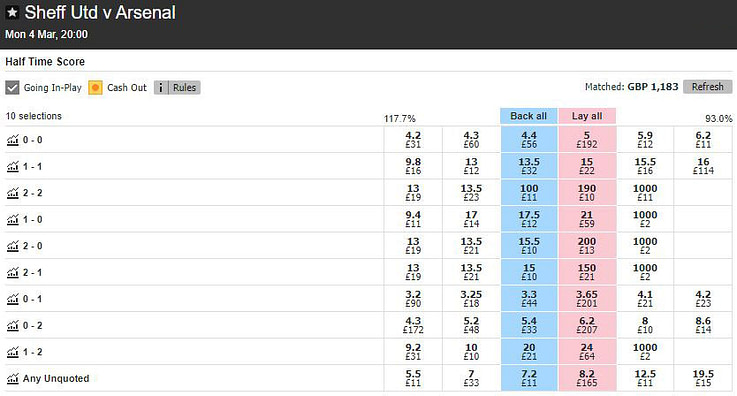
The downside is that market liquidity can be quite limited.
Also, of course, no team ever has to score in the first half. At least in the second half you know that teams will attack if they need a goal to equalise or win the game.
Second half correct score trading
Naturally, your next option is to wait until half-time before entering a trade.
With a second half correct score trade you use the full market, but the prices will have already moved a lot.
For example, the 0-0 price will usually be around a third of what it was at kick-off.
Quite a discount!
Whereas you will often be looking to target one goal in the first half, after half-time you can go after two or more goals much more confidently.
Of course, you still may not wish to lay the correct score at half-time, but if you're patient the prices will come into range.

Our second half correct score trading strategy offers some of the biggest potential returns.
It is quite an aggressive system, so doesn't suit everyone, but a goal or two at the right time produces a 'free bet' and a sizeable potential return.
Correct score trading example
Once you've backed your target scores and the game has kicked off, there are two elements to your trade:
- Reducing your liability (without creating too much risk).
- Banking a profit (without missing out on a bigger return).
Let's imagine you 'Dutch' 1-2 and 2-1 target scores for a total of £10.
Once matched, you will have an equal profit on each target score and all of the other possible scores will have £10 liability.

In order to reduce that £10 liability (your original stake) you can lay other scores.
For example, you could lay 0-0 for £10 and then just one goal would leave you with scratch (no profit or loss) and a free bet on 1-2 and 2-1.
The downside of this is that the 0-0 price to lay would be quite high, especially in the first half. That would leave you with a big loss if the game ended 0-0.
Is it worth the risk? Only you know whether you can stomach big losses from time to time. Personally, I prefer to avoid them.
A better option is to wait for the 0-0 price to fall (known as 'time decay') as long as no goals are scored. If a goal goes in, you can simply lay 1-0 instead.
Once you hit a target score, use the profit to at least remove your liability.
You may even be able to lock in a profit. The later you hit a target score, the more profit you'll usually end up with because the price to lay will be lower.
The challenge here is to use the profit available before the next goal is scored (if another goal is scored) without laying off all your potential profit too quickly at higher prices.
As you can imagine, this is a fine balancing act!
Sometimes you get it right, other times you wish you'd done something different. All you can do is make the best decision at the time and live with it.
Liquidity is also important.
More heavily traded matches generally make it easier to get your back and lay bets matched at suitable prices, whereas smaller leagues or less popular matches may have wider gaps between the available back and lay odds.
Assured Soccer Profits
This system (also known as 'ASP') has been generating consistent profits since 2011.
It was the brainchild of retired dentist Geoff Parle who spent a couple of years perfecting the trade selection process as well as the strategy itself.
ASP is completely different from target score trading!
Rather than wait for big winners to come along, most ASP trades end with a profit and this appeals to many more traders who prefer consistent bank growth.
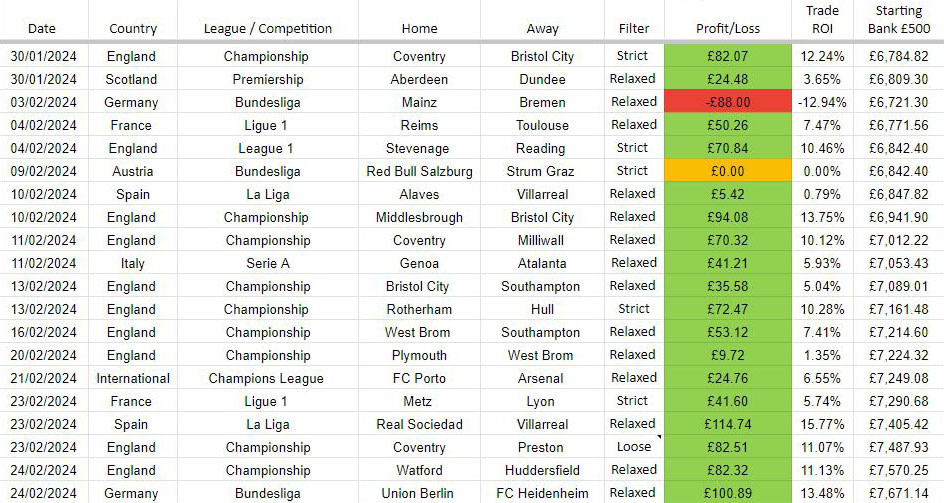
Goal Profits team member, Bryn Roberts, started trading with the Assured Soccer Profits system using a £500 bank.
Fast-forward six months and his bank had grown to £7,671.14.
Here's a snippet of Bryn's results sheet...
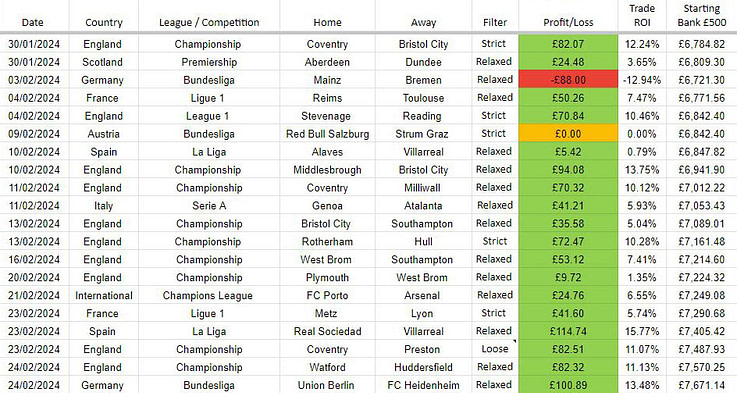
As you can see, this is very much part-time. Bryn doesn't even get into one day per day!
If you prefer this style of Correct Score trading, you can find out more about Assured Soccer Profits here. The User Guide explains the strategy and trade selection process in detail, with support also available.
Profit expectations
Depending on whether you trade target scores or you use the Assured Soccer Profits system, your profit expectations will be completely different.
Looking at target score trading first...
- It is possible to make a monster profit from one correct score trade
- It is not possible to make a profit from every correct score trade
One big target score hit can sometimes be enough to turn an entire weekend of football trading into profit. Of course, you don’t know in advance which trade will be the big winner.
Your aim as a trader is to get away with scratch wherever possible (no profit or loss) and bank small profits when opportunities arise, while waiting for a big winner.
Personally, I like to think of a scratch trade as a win! You have backed the target scores and then managed to recover your original stake.
Patience is key. There are likely to be runs of scratch trades and you cannot let temptation get the better of you.
Wait for the right opportunities, trade carefully and keep your risk under control.
Profit expectations are completely different for Assured Soccer Profits traders.
As you saw above, the vast majority of Bryn's ASP trades end in profit. This is because he started with a £500 bank and staked properly while learning the system.
It's unlikely that someone could start with a £10,000 bank and achieve the same profits right away but, with experience and practice, similar results may be possible.
As the old saying goes, 'learn before you earn' and this is particularly true with correct score trading.