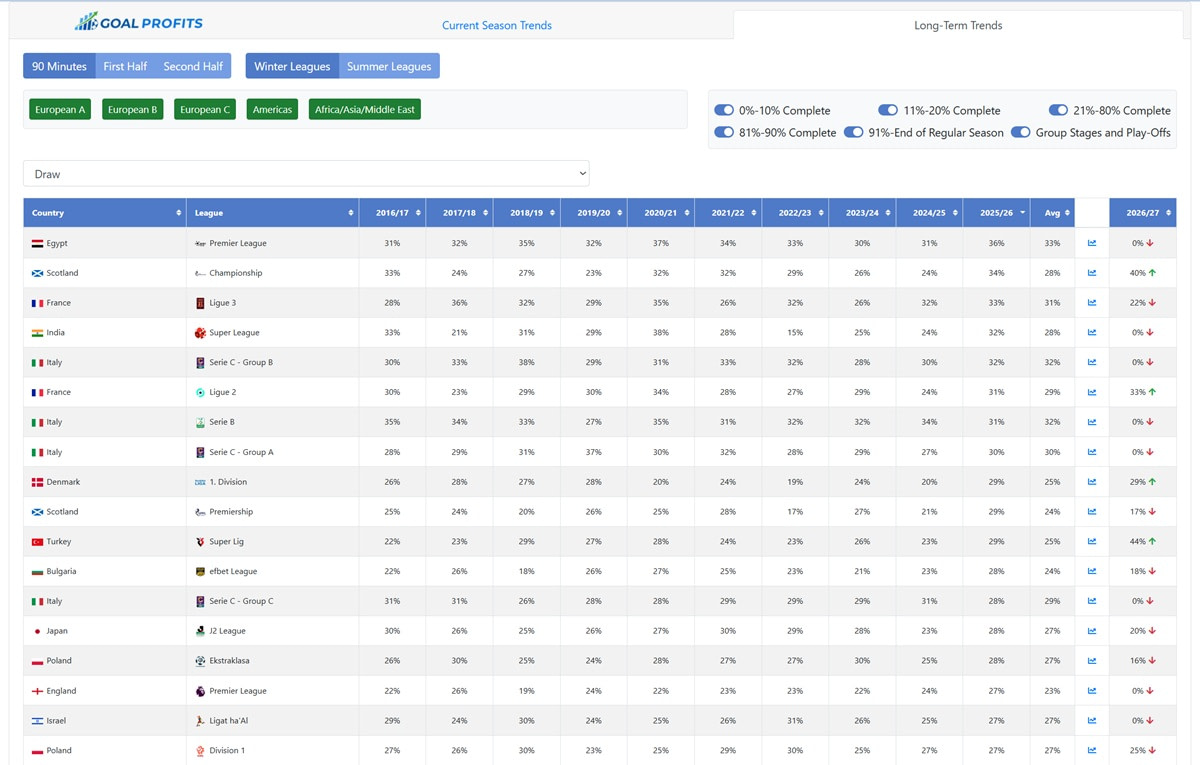


Over the past decade, an average of 7.8% of football matches ended 0-0. That works out at roughly one match in every 13.
That figure comes from the results tracked in our Team Stats database, which covers more than 80 leagues around the world.
For football traders though, the overall average only tells part of the story. The percentage can vary between leagues and from one season to the next, which is why it is useful to look a little deeper before making any trading decisions.
At Goal Profits, we use historical football data to research leagues, teams and potential trades rather than relying on one overall figure.
In this article, I'll look at how often football matches finish 0-0, how the numbers vary and what they can mean for football trading.
How often do football matches end 0-0?
The average percentage of matches ending 0-0 over the past decade was 7.8%.
Here are the annual averages from 2016 to 2025:
2016 | 2017 | 2018 | 2019 | 2020 | 2021 | 2022 | 2023 | 2024 | 2025 |
|---|---|---|---|---|---|---|---|---|---|
8.4% | 8.1% | 7.8% | 7.6% | 7.5% | 8.2% | 7.8% | 7.7% | 7.7% | 7.3% |
As you can see, the figure stayed fairly consistent throughout the decade, generally ranging from around 7% to 8.5%.
However, that does not mean every league behaves in the same way.
Do some football leagues have more 0-0 draws?
Yes. Goal averages and the number of 0-0 draws can vary considerably between different leagues.
For example, over the past decade, just 6.9% of matches in Italy's Serie A finished 0-0, compared with 9.8% in the Greek Super League. That's quite a difference!
Of course, as football traders we're only interested in leagues which go in-play on Betfair and have enough liquidity for football trading. Many smaller leagues don't attract enough trading activity, especially on a busy Saturday afternoon.
Our Team Stats database covers more than 80 leagues around the world. This means we can compare individual leagues, teams and seasons.
That is much more useful than just relying on an overall average.
How to use 0-0 statistics for football trading
Betting exchange markets are extremely efficient and all of these stats are taken into account when prices are set.
You may have wondered if it's possible to make a profit by simply laying 0-0, but the problem is you would be exposed to relatively large loss if a match did finish goalless.
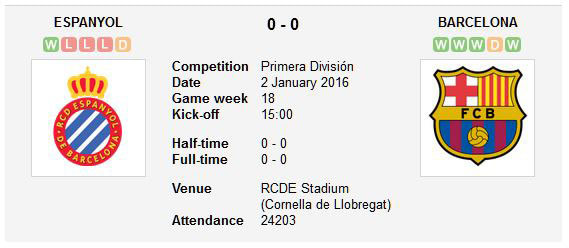
As you can see above, leagues perform differently from season to season and even Barcelona have 0-0 draws now and again!
This is why at Goal Profits our football trading strategies use a combination of research, suitable prices and in-play action rather than relying on one statistic.
A 0-0 result will always happen from time to time. The important thing is making sure your risk is appropriate when it does.
What percentage of football matches are draws?
Perhaps you are interested in all draws, rather than just 0-0. It may be that you have a back the draw strategy, or you like to lay the draw and need to avoid them.
The average percentage of matches ending as a draw over the past decade was 26.3%.
Our Team Stats Database can easily tell you how many matches end level, on average:
2016 | 2017 | 2018 | 2019 | 2020 | 2021 | 2022 | 2023 | 2024 | 2025 |
|---|---|---|---|---|---|---|---|---|---|
26.8% | 26.3% | 26.0% | 26.0% | 26.4% | 26.7% | 26.2% | 26.3% | 26.2% | 26.0% |
You can even break it down by individual league, such as the English Premier League, where an average of 23% of matches ended in a draw over the past decade:
2016 | 2017 | 2018 | 2019 | 2020 | 2021 | 2022 | 2023 | 2024 | 2025 |
|---|---|---|---|---|---|---|---|---|---|
25.1% | 24.4% | 22.1% | 21.1% | 24.7% | 22.8% | 21.1% | 20.9% | 26.3% | 22.0% |
Our Team Stats Trends tool allows you to rank leagues from high to low for a large number of stats. Perhaps you want to know what percentage of football games are 0-0 at half time, or how often do football games go over 2.5 goals?
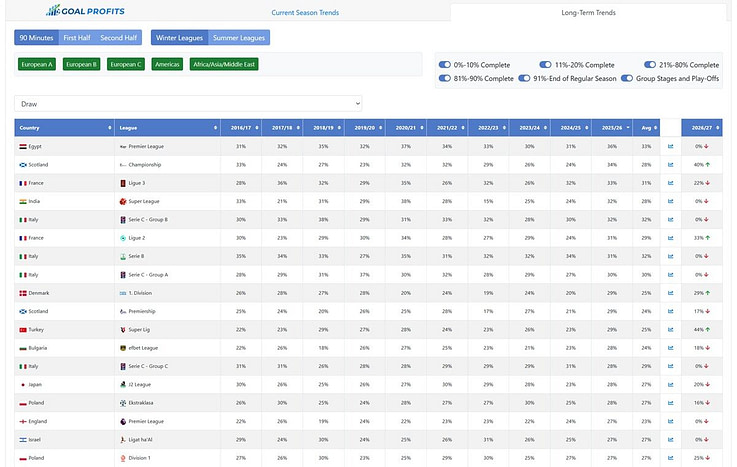
For this example, I'm looking at which leagues had the most number of draws during the 2025/26 season.
As you can see, the Egyptian Premier League topped the list in 2025/26, with 36% of matches ending in a draw.
At the other end of the table, the Singapore Premier League had the lowest percentage of draws during 2025/26, with just 11% of matches ending level.
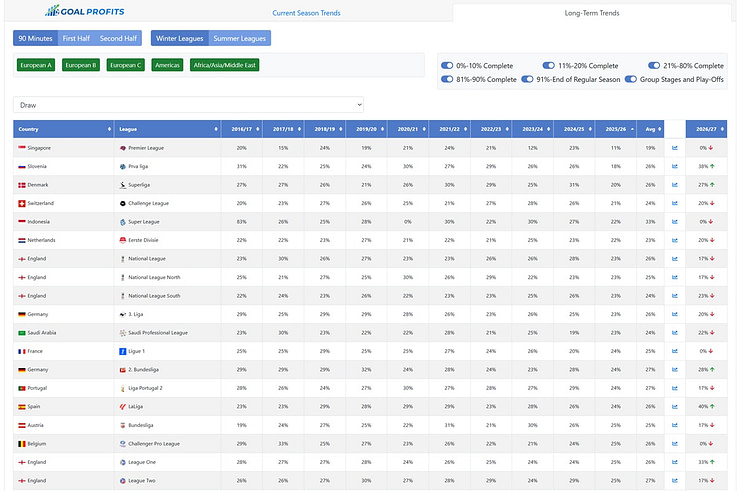
Team Stats Trends is particularly useful for beginners, giving you a quick overview of how different leagues tend to perform before you start researching potential trades.
Highest and lowest scoring football leagues
We can also look at the highest and lowest scoring leagues. If you're like me, then it's very useful to know the football leagues with the most average goals per game so that you can trade with more confidence.
Or, if you prefer to be on the other side of the book, then you will be interested in leagues which have fewer goals on average.
Here's the top and bottom ten winter leagues for the 2025/26 season:
Highest scoring football leagues
1. | Singapore Premier League | 3.6 goals per game |
2. | Switzerland Super League | 3.3 goals per game |
3. | Denmark Superliga | 3.2 goals per game |
4. | Germany 3. Liga | 3.2 goals per game |
5. | Germany Bundesliga | 3.2 goals per game |
6. | Netherlands Eerste Divisie | 3.2 goals per game |
7. | Netherlands Eredivisie | 3.2 goals per game |
8. | England National League North | 3.1 goals per game |
9. | Slovenia Prva Liga | 3.1 goals per game |
10. | Switzerland Challenge League | 3.1 goals per game |
Lowest scoring football leagues
1. | Egypt Premier League | 2.0 goals per game |
2. | Bosnia and Herzegovina WWIN Liga | 2.2 goals per game |
3. | Bulgaria efbet League | 2.3 goals per game |
4. | Italy Serie C - Group A | 2.3 goals per game |
5. | Italy Serie C - Group B | 2.3 goals per game |
6. | France Ligue 3 | 2.4 goals per game |
7. | India Super League | 2.4 goals per game |
8. | Italy Serie A | 2.4 goals per game |
9. | Japan J League | 2.4 goals per game |
10. | Portugal Liga 2 | 2.4 goals per game |
These overall figures are useful, but the real value comes from being able to compare individual leagues, teams and trends before you trade.
Team Stats gives you all of that in one place.