


For many punters, Betfair has become one of the most recognisable names in the world of online betting.
You can bet on a huge range of sports and markets, but what really makes Betfair different is its betting exchange.
If you have done any matched betting, there is a good chance you will already have a Betfair account, as the exchange is widely used for laying qualifying bets and free bets.
But the Betfair Exchange can also be used for something very different: sports trading.
Rather than placing a bet and waiting for the final result, traders can back and lay selections as the odds move before and during an event.
In this article, I’ll explain how Betfair works, look at its history and show why the exchange has become such an important tool for football traders.
A (very) short history of betting
People have been wagering money on sporting events for thousands of years, long before bookmakers and betting exchanges appeared.
Betting became much more organised in Britain as horse racing grew in popularity, although gambling laws changed considerably over the centuries.
One of the biggest changes for modern betting came with the Betting and Gaming Act 1960. This change meant licensed betting offices could open across Britain, and before long betting shops became part of everyday life on high streets across the country.
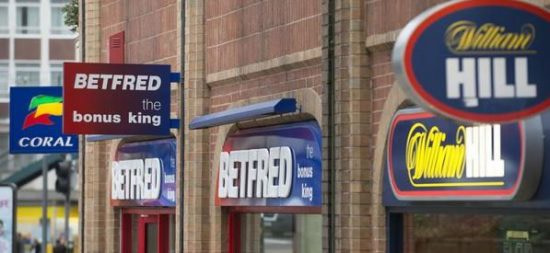
Betting shops were widespread prior to the move online, peaking at 15,000 shops across the UK.
There were thousands of them at their peak, although the internet eventually changed the industry completely.
These days, a huge amount of gambling takes place online. In 2025/26, the Gambling Commission reported £8.3 billion in Gross Gambling Yield from remote casino, betting and bingo.
It was during the early days of online betting that Betfair introduced something very different from the traditional bookmaker model: the betting exchange.
What is a betting exchange?
Betfair is best known for its betting exchange.
At first glance, an exchange looks quite similar to a traditional bookmaker. You can search for a football match, horse race or other sporting event and place a bet on the outcome.
The big difference is who you are betting against.
With a traditional bookmaker, the bookmaker accepts your bet. On a betting exchange, customers bet against each other, while Betfair provides the platform and matches the bets.
This also allows you to do something you generally cannot do with a normal bookmaker: lay an outcome.
When you back a selection, you are betting that it will happen. When you lay it, you are betting that it will not happen.
That ability to back and lay the same market is what makes a betting exchange so useful for sports trading.
There are four main betting exchange sites available in the UK. We look at how betting exchanges work and why you need an account at more than one of them.
Betting exchange vs bookmaker
Traditional bookmakers build a margin into their odds, giving them an advantage across the market over time.
A betting exchange works differently. Customers offer prices to each other, with the odds largely determined by supply and demand within the market.
For example, imagine a tennis match where two players are considered to have an equal 50% chance of winning.
Fair odds would be 2.00 on each player.
A traditional bookmaker might instead offer 1.91 on both players, creating a margin in its favour.
On an exchange, customers can trade closer to the true market price because they are betting against one another rather than directly against the operator.
Betfair still needs to make money, of course. It does this primarily by charging commission on net winnings in an exchange market. If you make a net loss on that market, no commission is charged.
Exchange odds can often be better than those available with a traditional bookmaker, particularly in liquid markets, although this will vary from market to market.
Another important difference is that consistently winning exchange customers do not create quite the same commercial problem for Betfair as they can for a traditional bookmaker. Betfair is providing the marketplace rather than normally taking the opposite side of the bet itself.
For football traders, though, the biggest advantage is the ability to both back and lay. That means you can enter a position and then trade out again as the price moves.
Betfair company history
Surprisingly, Betfair was founded before the industry began to move online.
The company is the brainchild of British entrepreneur Andrew Black, grandchild of former politician Sir Cyril Black, who himself campaigned for stricter gambling laws.
Black has proved himself to be a wild card, given that he made little effort at school and was viewed as a ‘rebel’ by his classmates and teachers.
However, Black excelled at maths, which would eventually lead him onto a Computer Science course at Exeter University, despite his seeming reluctance to learn.
However, his time as a student would be short-lived, as he was removed from the course ahead of his second year, as he had been skipping lectures in favour of spending time at the bookies.
Black moved back home to look after his sick brother and soon turned to gambling full-time to earn himself a living. Despite undertaking a string of jobs along the way, Black earned much of his money through the bookies.
However, his earnings were up and down, and he soon realised that he would be unable to support him and his family financially through betting alone and decided to set up a software business, which would eventually lead to the creation of Betfair.
However, despite focusing on his business, Black began playing bridge in his spare time.
It was through this that he met Edward Wray, an investment banker, who would soon become his business partner.
Black had spent much of his £50,000 savings developing a prototype known as the ‘Sporting Exchange’, which allowed customers to propose a wager, which others could then accept, or ‘lay’ against, meaning that the odds on an outcome were altered solely by market forces.
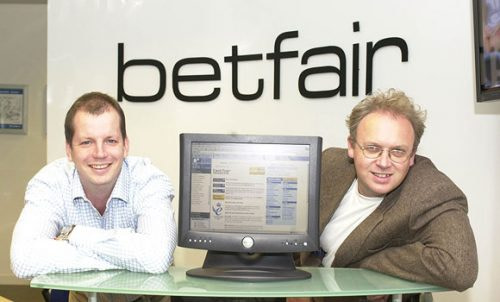
Andrew Black and Edward Wray founded Betfair back in 2000.
This was enough to impress Wray, but together they struggled to find investment, possibly due to the fact that online gambling had yet to really take off.
However, they eventually turned to friends and family, clawing together more than £1 million to develop and launch their product in June 2000.
By that point, an incredible amount of time and resources had gone into Betfair, but a successful launch proved that it was all worth it.
Despite only attracting a handful of customers, more than £35,000 was wagered in the exchange’s first week of existence.
There was still a long way to go, but Betfair had established the plausibility of a system that could rival, or beat, the bookmakers.
Flutter betting exchange
Betfair was not the only company experimenting with betting exchanges at the time.
Another exchange called Flutter launched shortly before Betfair in 2000 and became one of its main early competitors.
Betfair eventually acquired the Flutter business and absorbed its customers into the Betfair Exchange.
This early company should not be confused with Flutter Entertainment, the betting and gaming group which owns Betfair today.
That connection came much later.
Paddy Power Betfair becomes Flutter
Betfair kept growing over the next few years and became one of the biggest names in online betting.
In 2015, Betfair and Paddy Power announced plans to merge, with the deal completing in 2016. The combined company became Paddy Power Betfair plc.
Paddy Power shareholders owned approximately 52% of the new business, with Betfair shareholders owning the remaining 48%.
2016 saw Betfair merge with Paddy Power.
In 2019, Paddy Power Betfair became Flutter Entertainment plc, by which point the group had grown well beyond just Paddy Power and Betfair.
Betfair remains part of Flutter Entertainment today, alongside brands including Paddy Power, Sky Bet and others.
Despite all of those changes in ownership and branding, the Betfair name has remained firmly attached to the exchange.
Betfair's other services
Betfair is no longer just a betting exchange.
The brand also operates a traditional sportsbook, casino and other online gaming products. Flutter currently describes Betfair as a sportsbook, casino and exchange.
For sports traders, however, the exchange remains the most important part of Betfair.
It allows customers to back and lay selections, place bets at prices offered by other users and trade positions as the odds move.
That is what separates Betfair from a standard bookmaker and why the exchange remains so widely used by sports traders.
How to trade football on Betfair
There are plenty of different ways you can trade football on Betfair.
Some strategies are relatively simple to understand, while others involve several markets or trading positions.
Lay the draw is one of the best-known examples. A trader might lay the draw before backing it again later at a higher price if the odds move in their favour.
Goal markets are also popular because the prices can move significantly as time passes and goals are scored.
The Correct Score market is another good example of why an exchange can be useful.
If you were placing a traditional bet on the final score, you would need to predict the result correctly and wait until the match had finished.
A football trader does not necessarily need to do that.
You can enter and exit a Betfair market while the match is still being played, allowing you to react to changes in the score, time remaining and market prices.
That flexibility is one of the biggest differences between football trading and traditional betting.
Rather than relying entirely on the final result, you can trade shorter periods of the match and decide when you want to close your position.
Betfair pioneered the betting exchange back in 2000, and it remains the biggest exchange in the world today.
For football traders, the ability to back and lay within the same market is still what makes it such a useful platform.