


Back and lay betting is a way of betting where you can either back an outcome to happen or lay it not to happen.
This takes place on a betting exchange such as Betfair or Smarkets, and unlike with a traditional bookmaker, it allows you to trade your position before an event has finished.
As a football trader, you will attempt to anticipate events such as goals, as well as price movements caused by the time remaining in a match.
When the odds move in your favour, you can back at a higher price and lay at a lower price - or lay low and back high - to lock in a profit or reduce a potential loss.
Once you understand how backing and laying for profit works, you can begin using them as part of a wider football trading strategy.
First things first though, here is back and lay betting explained step by step.
What does back and lay betting mean?
A traditional bookmaker takes 'back' bets. You back an outcome in a betting market and the bookie pays out if your bet wins.
However, betting exchanges - such as Betfair - allow you to 'back' or 'lay'.
As well as being able to 'back' an outcome, you can also take on the traditional role of the bookmaker and 'lay' it. In other words, your bet wins if the outcome of an event doesn't happen.
For example, let's say you are interested in placing a bet on a match odds market.
You can see the back and lay odds of an example match below:
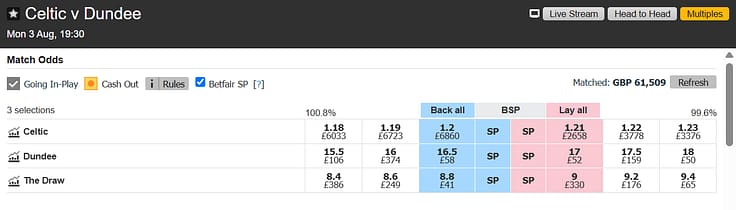
On Betfair, back odds are displayed in blue and lay odds are pink.
In this example, Celtic are the favourites to win the match with back odds of 1.20.
This means that if you back Celtic with a £10.00 stake, your return will be £12.00 (£2.00 profit before Betfair commission is deducted) if they go on to win.
A lay bet is the exact opposite, so you are betting on something not to happen.
If you lay Celtic, you are betting on them not to win the match.
That means if Dundee win or draw, your lay bet wins.
Being able to both back and lay is what makes sports trading possible on betting exchanges like Betfair, as traders can open and close positions when the odds move.
Lay bet liability
When placing a back bet, you can never lose more than your stake. However, when you lay a bet, the liability can be a lot more than your stake and you must be fully aware of the risk before placing your bet.
In the Celtic vs Dundee example, Celtic are 1.20 to back and 1.21 to lay.
If you decide to lay Celtic for a stake of £10, you will win £10 if Dundee win the match or if it ends as a draw.
If Celtic do go on to win the match, your liability will be determined by the lay price.
In this case, it would be (£10 x 1.21) - £10 = £2.10

Backing and laying are simply opposites:
- Back Celtic with a stake of £10 at 1.20 to try and win £2.00
- Lay Celtic with a liability of £2.10 to try and win £10.00
When placing a lay bet, your liability is always deducted from your account balance as Betfair has to assume the worst case scenario - that you lose your bet.
Therefore, you can never risk losing more than the money you already have in your Betfair account.
The lower the lay odds, the lower your liability.
This is one reason why many football traders prefer to wait for prices to move before entering a trade, rather than laying selections at very high odds.
Once the match result has been decided, the market will be settled.
Bear in mind that if you get involved in long-term trades, such as a Premier League season winner, you may have a large liability tied up for many months
Remember, Betfair also charge a small commission on winning bets.
There are four main betting exchange sites available in the UK. We look at how betting exchanges work and why you need an account at more than one of them.
Low-risk lay bets
In the example above, laying Celtic produced a smaller liability than the potential profit.
It would certainly be considered a low-risk lay bet because a number of things could go against them during the match.
However, if you were to lay Dundee, the price would have been 16.50 and you would be risking much more money than your potential profit.
Here's the match odds market once more...

The Draw was priced at 9.00 to lay, so a £10 stake would result in a liability of (£10 x 9) - £10 = £80.00.
When trading individual games though, you don't always need something to happen in order to move market prices. Sometimes, you can take advantage of better prices just by waiting.
For example, the 0-0 price at kick-off will be a very high price to lay, but by half-time it's often a third of the starting price. This movement is called 'time decay' and it continues all the way to the final whistle unless a goal is scored.
If you're patient - which is essential for profitable football trading - you could lay 0-0 in a game with a team desperately trying to score as time runs out. Rather than risk many times your stake, you'll be making sure that the risk/reward is in your favour.
It's much better than sweating on a goal because you couldn't wait to get into the trade and created a huge liability!
Spend some time watching the Betfair markets and see how prices move - even without goals.
Lay betting strategy
Making money on Betfair is all about backing and laying at the right times.
A great example of how dramatically football odds can move comes from the 2015–16 season. Although it was over a decade ago, the same trading principles still apply in 2026.
At the start of that season, Leicester City were available at a huge price to win the Premier League, but their odds became much shorter as they closed in on the title.
Euro 2016 provided another good trading opportunity.
Unsurprisingly, the favourites were the traditional powerhouses of European football – Germany, France and Spain.
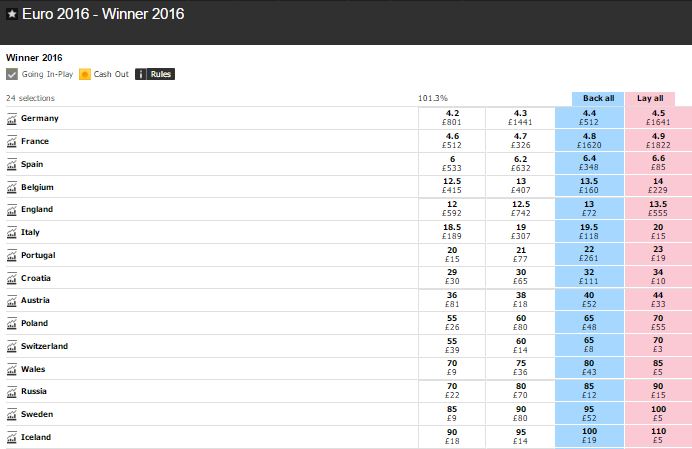
Further down the list, however, there were opportunities to back up and coming teams at high prices.
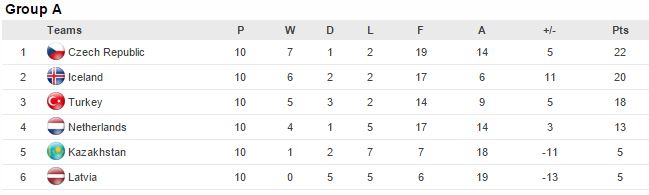
Iceland were one of the major surprises during qualifying, finishing in second place in Group A.
As they recorded a string of stunning results during - including wins home and away against the Netherlands - their odds to win Euro 2016 started to steadily drop.
It was a fantastic back-to-lay opportunity, with traders who backed Iceland earlier at odds of 500/1 able to lay at much shorter odds in order to lock in a profit.
Iceland drew Portugal, Hungary and Austria in Group F of the Euro 2016 finals, with the top two from the group going through to the next round, as well as the best third-placed team.
It was a test for them, but their fantastic success in qualifying showed how capable they had become at international level in recent years.
Greece's historic success at Euro 2004 proved that smaller countries can thrive at the European Championships and, even with the new reorganisation to a 24 team event, Iceland had a chance.

Before the tournament began, Iceland were priced on the Betfair exchange at 100 to win Euro 2016, meaning a £10 back bet on Iceland would have resulted in a profit of £990 should they have taken the title.

Once Iceland qualified from Group F, their odds dropped substantially, meaning it was then possible to place a lay bet to lock in a good amount of guaranteed profit. After their win against England, their odds came down even further.
How to trade out of a bet
Once you have backed or layed a selection and something has happened to move the price, you may wish to exit your bet.
For example, if you have placed a back bet on Celtic at 1.20 and they are 1-0 up after 10 minutes, you will be able to lay them at a lower price to remove your risk.
On the other hand, if you have placed a lay bet on Celtic at 1.21 and they're 0-1 down after 10 minutes, you will be able to back them at a higher price in order to secure a profit.
This is how football betting becomes football trading.
Working out your exit stakes can be tricky at first, but our free hedging calculator makes it very quick and easy.
Common questions
What is the difference between backing and laying?
Backing is the traditional way to bet. You are betting that something will happen, like a team winning a match.
Laying is the opposite. You are betting that the selected outcome will not happen. For example, if you lay a team to win, your bet wins if they lose or draw.
When you place a lay bet, you are effectively stepping into the shoes of the bookmaker!
What does "liability" mean in lay betting?
Liability is the amount of money you are risking if your lay bet does not win.
When you act as the bookmaker, you must pay out if the selection you laid goes on to win. For example, if you lay a team at odds of 4.00 with a £10 stake, your liability is £30.
That is how much you will lose if the team wins the match.
Can you lay a bet with a traditional bookmaker?
No. Traditional bookmakers such as Sky Bet and William Hill already take the role of the bookmaker, so they normally only allow customers to back outcomes.
To place a lay bet, you need to use a betting exchange such as Betfair, Smarkets or Matchbook. Betting exchanges allow customers to bet against one another.
What happens if a lay bet wins?
Your lay bet wins if the outcome you bet against does not happen.
For example, if you lay a team to win, your bet succeeds if the match finishes as a draw or the opposing team wins.
Your profit is the lay stake, minus a small commission taken by the exchange.
What do the odds colours mean on Betfair?
The Betfair exchange can look a little daunting at first, but the colours make it easier to distinguish between the two sides of the market.
Blue boxes show the available back odds and pink boxes show the available lay odds.
Just remember “blue to back and pink to lay”.
Is backing and laying the same as using Cash Out?
Cash Out is based on the same principle of closing your position before an event has finished to lock in a profit or reduce a potential loss.
However, the Cash Out amount offered is often not the best available. Rather than accepting that price, you can place the opposite bet yourself at odds you are happy with.