


A second half goals trading strategy is based around finding matches where you expect one or more goals after half-time.
There is a good reason why the second half can be lucrative for traders. Our long-term data shows that more than 77% of matches have at least one second-half goal.
Across all leagues, the average is around 1.15 goals in the first half compared with 1.50 in the second half.
One of the biggest differences compared with first-half trading is that what happened during the opening 45 minutes can influence whether you get involved after the break.
You can use the score, in-play stats and how both teams have performed to help make that decision, which is one of the big advantages of second-half football trading.
How does second half goals trading work?
As the second half progresses without a goal, the odds on goal markets will generally continue to rise.
This gives you the option of waiting for a better price before entering, although there is always a balance between getting attractive odds and leaving enough time for the goal to arrive.
If a goal is scored after you enter, the price can move sharply in your favour and give you an opportunity to trade out.
Exactly how you manage the position will depend on the market, the strategy you are using and how much time is left in the match.
Why the first half matters
The half-time score can have a big influence on how you approach the second half.
If a strong home favourite is 1-0 up, they don't necessarily need another goal to win the match. Their opponents still have to push for an equaliser, which can create space at the other end.
If the favourite is 0-1 down, you would normally expect them to be much more attack-minded after the break. The market will usually account for that too, so the price may not be as attractive.
A 0-0 half-time score can be more difficult to judge, particularly when there is no clear favourite. In that situation, it becomes even more important to look at whether either team is likely to push for the win rather than settle for a draw.
Whatever the score, you're ultimately looking for the same thing: at least one second-half goal.
We also have a separate guide to our first half goals trading strategy if you want to compare the two approaches.
A second half goals trading example
Let's say a match is still 0-0 after 70 minutes and the in-play stats show a lot of action with recent shots and corners. You decide to back Over 1.5 Goals at odds of 4.00.
A goal is scored a few minutes later and the price drops sharply because only one more goal is now needed.
At that point, you have a couple of options for your exit strategy. You could trade out and lock in a profit on both outcomes, or secure scratch on the current score and leave more profit on another goal.
This means you don't necessarily need two second-half goals to make money from the trade. One goal can often be enough to give you a profitable exit or at least remove most of the risk.
The amount available will depend on your entry price, when the goal is scored and how much time is left in the match.
Finding second half trades at Goal Profits
Finding suitable matches is one of the most important parts of any second half goals trading strategy.
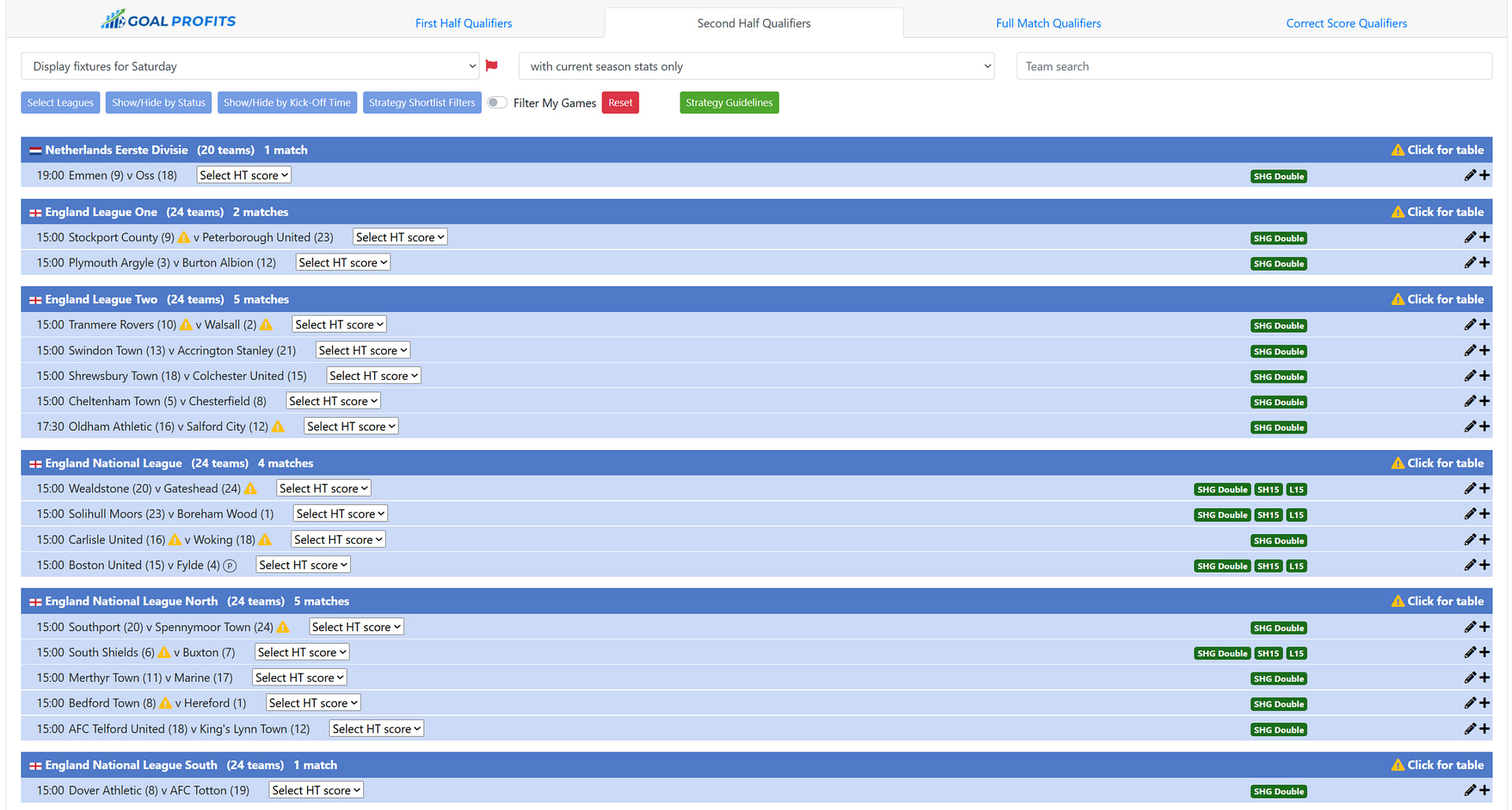
At Goal Profits, Today's Qualifiers shortlists matches that meet the criteria for our different strategies, so you don't have to work through every fixture manually.
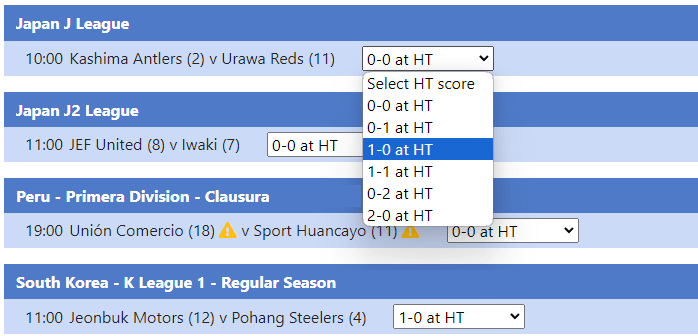
Once the first half has finished, Team Stats can also update the data for the match based on the actual half-time score.
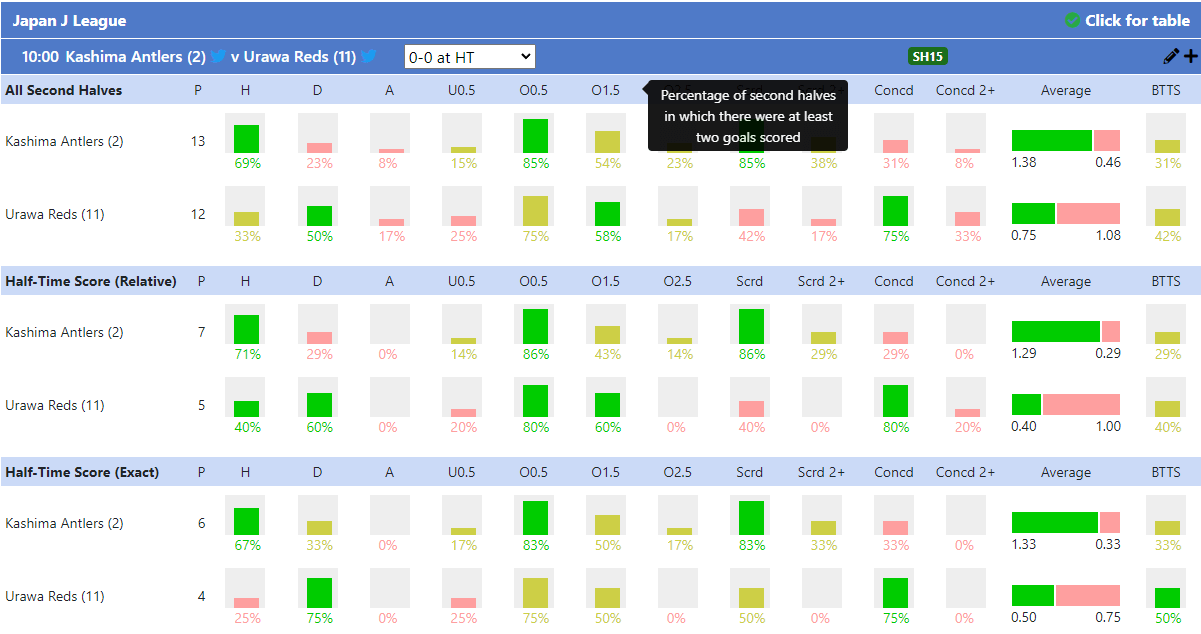
If a match is 0-0, for example, you can view the historical stats for previous matches that were also exactly 0-0 at half-time. You can also switch to a relative scoreline, which would include any match that was level at the break rather than only 0-0.
This gives you another way to judge how similar matches have performed from the same half-time position before deciding whether you want to get involved.
Second half trading strategies
At Goal Profits, two of our main second-half strategies are SH15 and L15.
SH15 is based around finding matches where there is a good chance of two more goals being scored in the second half.
The exact market will depend on the score when you enter. For example, at 0-0 you might use Over 1.5 Goals, while at 1-0 or 0-1 you would be looking at Over 2.5 Goals.
Entries can be taken from around 5-10 minutes into the second half, although some traders prefer to wait longer.
You don't necessarily need both goals to make money from the trade either. One goal can often be enough to secure scratch and leave profit on another goal, or trade out for a profit across the different outcomes.
L15 focuses much later in the game and is aimed at matches where there is still a good chance of a late goal during the closing stages.
The two strategies therefore approach the second half from slightly different angles, but an L15 qualifier can add extra confidence to an SH15 trade.
Goal Attack can also be used during the second half, although we don't class it specifically as a second-half strategy because some traders enter earlier in the match.
You can learn more about these and our other Goal Profits trading strategies in the Academy.
Why wait before entering?
Waiting can make a big difference to the price you receive.
If you enter a goals market at half-time, the odds will usually be lower than they are after another 10, 15 or 20 minutes without a goal.
That can make later entries more attractive, but there is an obvious trade-off.
The longer you wait, the less time there is for the goal to arrive.
That is why there isn't necessarily one perfect entry point. You are looking for a balance between price, time remaining and what you are seeing from the match.
Strong in-play stats can support the decision to enter, but if the game has gone flat or isn't producing enough attacking threat, there is no reason to force a trade just because it appeared on your shortlist.
What happens if a goal doesn't arrive?
Not every second-half trade will work.
If the score stays the same, the odds will continue moving against your position as full-time gets closer.
This is why staking and good bank management are so important.
You should know how much you are prepared to lose before entering and avoid increasing stakes or trying to recover a previous loss.
The aim isn't to win every trade. It is to keep individual losses under control and make sure one result doesn't do unnecessary damage to your bank.
Is second half goals trading right for you?
Second half goals trading gives you plenty of different ways to approach a match.
You might get involved fairly early after the break, wait for a better price later on, or leave the match alone completely if the in-play stats aren't strong enough.
The main advantage is flexibility. You can combine pre-match research with what you are seeing live, then decide whether the price and match situation make sense.
For me, that is where the appeal comes from. You are not tied to one entry point or one type of game, and you can adapt your approach as the match develops.